Showing posts with label Belgian abdication. Show all posts

Monday, 30 December 2013

Royal pictures for 2013: Belgium

The abdication of Albert II, King of the Belgians came as a surprise to many and certainly hadn't been predicted at the start of 2013.  Instead, the country began the year by looking forward to the planned celebrations in August for the king's 20th jubilee but on July 3rd 2013 he went on television to tell his fellow citizens that he planned to stand aside in favour of his son on Belgium's National Day, July 21st.  The royal household released an image of the king just before his abdication which gave Albert's departure an emotional touch.


Albert II, King of the Belgians, 1993 - 2013, leaves the stage

King Albert and his consort, Queen Paola, embarked on a farewell tour of the country where they were greeted by huge crowds everywhere they went.  The tour ended in Liege, the city of which Albert was made prince on the day of his birth.  Queen Paola found it hard to contain her tears as the monarchs bade an emotional farewell to their fellow citizens before handing over to a new royal family.


Tears of a queen - Paola of the Belgians says farewell in Liege, the area of which she was princess for decades before Albert's unexpected accession to the throne in 1993

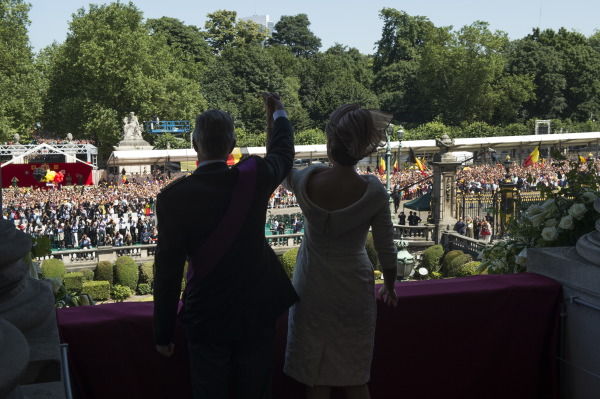
The actual day of abdication and accession was a joyful occassion which began with a Te Deum in Brussels before the outgoing king signed away his kingdom and his successor took an oath of allegiance in front of politicians and family members.  Philippe, King of the Belgians then rode through the streets of Brussels to greet his fellow citizens as their monarch for the first time before a balcony appearance where all eyes were on his consort, Mathilde, the first Belgian born queen of the country.


Mathilde, Queen of the Belgians, with her husband, Philippe, on the day of their accession, July 21st 2013

The new royal family kept a low profile after the accession with the king taking on many new functions while the royal children - including the first heiress to the throne, Princess Elisabeth - carried on with their normal routines.  And at the beginning of September there was a chance to see a king on the school run.


King Philippe of the Belgians takes three of his four children to school on the first day of term in September 2013

Belgium now has two kings and three queens and Fabiola, consort of Baudouin, led the tributes to her late husband in August on the twentieth anniversary of his death.  While the former king and his successor and the two most recent consorts stood by, it was the poignant sight of Fabiola being wheeled towards a giant photo of the man she loved for decades during a religious service to commemorate his life that really stuck in the memory.


A queen remembers her lost love - Fabiola of the Belgians at the memorial service for her late husband, King Baudouin, in August 2013


Sunday, 21 July 2013

A princess becomes an heiress

A future queen regnant made her first appearance as heiress to the throne today.  Princess Elisabeth of Belgium was the first child born to this new generation of European royals.  Today, aged 11, she becomes her father's heir.  She was regal in red and watched closely by her mum, Queen Consort Mathilde, through the swearing in ceremony that saw dad become king.  And little Elisabeth took charge of her brothers, Gabriel and Emmanuel, and their sister, Eleonore, with all the style of a future head of the royal house.


The royal household in an official photograph released on the evening of Sunday 21st July on the day that Philippe succeeded Albert II as King of the Belgians
 
For now she is the heiress and faces the challenge of learning the royal ropes while learning alongside her future subjects as she continues her education.  But her life has changed subtly as shown in the official photo released this evening by the Royal Household.  King Philippe stands centre stage with King Albert II at his side and in front of them, Princess Elisabeth, who one day will become her country's eighth monarch and its first Queen Regnant.

Queens are grandmas too

Now that she's got a bit of time on her hands, Paola can do what all grans love to do and that's spend a bit more time with the grandchildren

Just as Queen Beatrix's first appearance after her abdication involved her looking after the new king's children on a big state occasion, so Albert II and his consort, Paola, re-appeared this afternoon in charge of the next generation.

 
From queen consort to doting grandma - Paola brings the next generation of Belgian's royal family to one of their father's first state appearances
 
 
While their dad, Philippe, took charge of the military review, the recently abdicated Albert and Paola looked after new heiress to the throne, Elisabeth, and her brothers and sister.  It was reminiscent of the way that the now Princess Beatrix guided her granddaughters through the events that followed their father's accession as King Willem-Alexander.  It must be one of the highlights of giving up a throne - spending more time with your family.
 
 
The recently abdicated Queen of the Netherlands, now Princess Beatrix, gets some time with the grandchildren on the day she gave up her throne, April 30th 2013
 
Sixty years ago another queen consort by then converted into a queen dowager famously watched her grandson as her own daughter became Queen.  One of the best known images of the coronation of Elizabeth II shows her heir, four year old Prince Charles, observe proceedings next to Queen Elizabeth, the Queen Mother.  Sixty years on, granny still knows best.
 
 
 Queen Elizabeth, the Queen Mother with Charles, Prince of Wales and Princess Margaret at the coronation of Elizabeth II on June 2nd 1953

 
Photos Dutch Royal House and Belga


Belgian abdication in pictures

About half way through the festivities and time for a look at some of the best photos so far of the accession of King Philippe following the abdication of King Albert II.

 
Albert II and Paola wave goodbye after the Te Deum that began the day's proceedings in Brussels
 
 
The king signs away his crown watched by the Belgian Prime Minister, Elio di Rupo
 
 
The abdication of the King of the Belgians, Saturday July 21st 2013, Palais Royale, Brussels
 
 
Two kings together - father and son
 
 
Philippe is sworn in as King of the Belgians
 
 
The Belgian royal family - past, present and future - at the swearing in
 
 
Eleonore, Gabriel, Elisabeth and Emmanuel watch their father become king
 
 
The king presents his queen to the people of Belgium
 
 
A new royal family for Belgium, July 21st 2013

 
 The official portrait of King Philippe and Queen Mathilde of the Belgians

 
All the kings and queens of Belgium in a photo called Rois et Reines by the Royal Household when it released the official portraits to mark the beginning of Philippe and Mathilde's reign
 
Photos from the Belgian Royal Household website and Belga Pictures

Paola, the princess from the south who became a Queen of the North

Paola became queen against her expectations.  She began life as minor Italian royalty and thought, when she married Prince Albert of Belgium in 1959, that she was entering a life that would move her into minor Belgian royalty.  Her groom may have been heir to the throne on their wedding day but his brother, King Baudouin, was just 29 and still to marry.  As the new Prince and Princess of Liege left their wedding, they expected to move into obscurity behind the family of the king.


Paola as Queen of the Belgians, a role she never expected to take on
 
But become queen she did.  This future monarch was born on September 11th 1937 in Tuscany.  Her father was Fulco VIII, Prince di Ruffo di Calabria who married Luisa Gazelli in 1919 and Paola was the youngest of their children, born just before World War Two.  Her father had been a high profile pilot during World War One but he was convicted of complicity with the fascist government of Mussolini after the Second World War ended and died not long afterwards.  Paola was a princess in name but in search of a role and a family.
 
 
Paola was feted as one of Europe's most beautiful women in her youth
 
 
She met the heir to the Belgian throne, Albert, in 1959 at a reception for the inauguration of Pope John XXIII held at the Belgian embassy in Rome.  She recalled them both being shy but romance flourished and the couple married in Brussels on July 2nd 1959.


Albert and Paola on their wedding day - she became Princess of Liege on her marriage
 
 
With the marriage of Albert's brother, King Baudouin, the following year Paola expected to move further away from the throne of Belgium. The couple had three children - Philippe, Astrid and Laurent - within three years but as their family grew it was becomingly increasingly clear that Baudouin and Queen Fabiola might not have children.  By the late 1970s it was accepted that Baudouin would have no heir of his own. The throne would pass to Albert.
 
 
Paola was Princess of Liege from her marriage in 1959 to 1993 when King Baudouin died


Despite speculation about the state of the royal marriage and then rumours that Baudouin might nominate their eldest son, Philippe, as his heir Albert and Paola became King and Queen of the Belgians in August 1993.  Paola was the last woman to become a Queen Consort in Europe in the 20th century.  She has been popular and known for her love of the arts and her work for charity.  And in an interview to mark her 70th birthday she addressed the chatter about the state of the royal marriage, acknowledging difficulties but saying that they were meant for one another and were very happy together.
 
 
A love that lasted - Queen Paola kisses her husband, King Albert II of the Belgians, on the even of his abdication in July 2013
 

Today they enter retirement with the good wishes of their people.  How history remembers her is still to be decided.  But the littlest girl of a minor Italian royal has ended up the most successful of his children and takes her place as the last European queen consort of the 20th century.


Kings, queens and kisses

His father's last act as king was to send a big kiss to his queen consort.  And as Philippe took over from Albert II as king of the Belgians, his first act was to plant a kiss on the cheek of his own consort, Mathilde.  She returned the gesture and for a moment it looked like they might even give us the first coronation on the lips smacker.  But they resisted and waved instead.  Belgium's abdication and accession has proved to be a royal romance.

 
A kiss for his queen - Mathilde and Philippe greet the crowds at the Place des Palais in Brussels less than an hour after his formal accession as King of the Belgians
 

Queen Mathilde of the Belgians

Mathilde of Uccle is now Queen of the Belgians.  She became consort of the country at 12 noon Brussels time when her husband, King Philippe, swore his oath of allegiance before the two houses of parliament in the country's three languages, French, Flemish and German.

Europe has a new queen.

 
An official portrait of Queen Mathilde who began her reign as consort on Sunday July 21st 2013
 

In between queens

Albert II has abdicated, his queen consort passes into history with him.  Paola remains a queen but until 12 noon Belgium is without reigning monarchs as Philippe and Mathilde don't become king and consort until he swears his oath of allegiance.

For the next hour or so, the throne of Belgium is technically empty and the country is between kings and queens.


The former king of the Belgians, Albert II, presents the soon to be monarch to his people at the Palais des Beaux-Arts on the evening of Saturday July 20th 2013

Albert II has abdicated

The document is signed, the witnesses have written their names into history.  The national anthem has been played and the king has left the stage.  Au revoir, Albert et Paola.


The sun sets on the reign of Albert II and Paola, now former King and Queen of the Belgians

Merci, Paola - Albert's kiss for his queen

His last words as king were for his queen.  Albert II, on the point of abdication, thanked his queen consort Paola for her support.  And as his tenure reached its end he said he sent her a big kiss.  Romance at the end of a reign.  The queen wiped away a tear as those gathered to witness the passing of the crown applauded her.  And her king smiled on.


Albert II pays tribute to his queen consort as he makes his final speech as King of the Belgians
 
More thanks from Elio di Rupo, Prime Minister of Belgium who said the people of Belgium in particular appreciated her support and that they had taken their queen to their hearts.

And as the abdication ceremony takes place at a table in the Palais Royal, behind the soon to be former king and his successor, the three queens look on.  Mathilde, Paola and Fabiola, the first witnesses of this historic day.

Two kings and two queens

The abdication of Albert II is about to get underway as the royal family attends a Te Deum at the Cathedral of St Michel and St Gudula in the heart of the Belgian capital, Brussels.

After that, Albert II returns to his palace with his queen consort, Paola, to sign over his kingdom.  Philippe and the future queen consort, Mathilde, then make their way to the Belgian parliament for the formal swearing in ceremony.

Last night the two kings and two queens kicked things off by attending a concert at the Palais des Beaux-Arts and then joined in the party at the 10th annual Bal National.

 
Queen Paola, King Albert and the Duke and Duchess of Brabant at the Bal National, Brussels, Saturday July 20th 2013
  
And an interesting photo in the official gallery at Belgian royal household's official website on Abdication of King Albert II.  Amongst the festivities and flags a lone photo of a member of the rotal family - the soon to be queen consort, Mathilde.  This royal wife will have a very big role in the future monarchy led by her husband.
 
 
The people's choice - a photo of Mathilde is held aloft amidst the flags at the start of the abdication  and accession ceremonies


Au revoir, Albert


The reign of Albert II, King of the Belgians and his queen consort, Paola, is over
 
Today marks the changing of the guard in Belgium.  Albert II's abdication will usher in a younger monarchy with its new king. 

Almost 62 years ago to the day Albert watched his father, Leopold III, abdicate in favour of his older brother, Baudouin, turning Albert himself into heir to the throne.  His sister, Josephine-Charlotte, and his half brother, Alexander, also looked on along with his father's second wife, Princess Lilian.  They are all dead now and the teenager who became heir to the throne of Belgium on that July day in 1951, but who never expected to be monarch, today hands on his kingdom to his own son.

In almost twenty years as king he won the respect of his people with his steadiness, his calmness and, in most recent times, his determination to find a solution to the political crisis that had engulfed the nation when the political parties couldn't form a government. 

His own story has been checkered - he lost his mother when he was one, spent part of his childhood as a prisoner after the Nazi occupation of Belgium and saw his father in exile.  He watched his brother shoulder the great burden of state that came with kingship and while he formed a family, saw that same brother and his wife suffer five miscarriages. 

He misses his 20th anniversary by just a few days.  But what better time to usher in a new king that on the national day.  Albert II and Paola have bowed out and a new king and queen of the Belgians take centre stage.

Saturday, 20 July 2013

The king and queen's last dance

Albert II has said goodbye to his subjects and all that's left now is the last dance.

The King of the Belgians will abdicate tomorrow at 10.30, Brussels time, leaving his country king-less for 90 minutes before his son and heir is sworn in as the new monarch at 12 noon.

Tonight Albert made an emotional TV address to bring his twenty year reign to an end.  And in it he made his wishes for his soon to be former kingdom.  He hoped for cohesion after a tumultuous few years in which he saw his realm without a government for over 500 days.  He asked his fellow Belgians to support their country's role in the European Union which he said he believed was the best way to defend democracy.  And he asked for support for the new king and queen. 


All change - King Albert II asked his fellow Belgians to support his son and heir, Philippe
 
Before he became king there was speculation that the crown might pass directly from Baudouin to Philippe.  Albert's reign took some by surprise.  But there is little doubt that in some way he has proved all his doubters wrong - his rule has been more of a success than many predicted when he took his oath in front of parliament in August 1993.


Flowers for a king - surrounded by smiles, Albert II on his last public engagement before abdication
 
From the TV address the king heads into the warm night air of an unseasonly warm Brussels to a concert at the Palais des Beaux-Arts and then into the crowds at the 10th Bal National, the event that takes place the evening before Belgium's national day.  There will be singing and a chance to dance - a last waltz for this king and queen?

And then, the official process of abdication begins.  Tomorrow will be formal with moments of festivity for a new king and queen.  But tonight there are celebrations of a reign that was unexpected, almost missed and ultimately more of a triumph than either the king or his queen consort ever thought it might be.


The king prepares to leave the stage - all that's left is a last dance with his queen

Queens of the Belgians

It's not often we get a new queen consort - we've been rather spoiled this year with two in close succession and in the happy circumstances of taking the crown without the sadness of a family death preceding the event.

Tomorrow, Mathilde d'Udekem d'Acoz becomes queen of her country and the first Belgian to be consort of her people.  To mark the occasion a run down of the six Queen of the Belgians ending with the woman soon to join their ranks.


Louise-Marie, Queen of the Belgians 1832-1850
Consort of Leopold I of the Belgians, ruled 1832 - 1865

 
Marie Henriette, Queen of the Belgians 1865 - 1902
Consort of Leopold II of the Belgians, ruled 1865 - 1909
 
 
Elisabeth, Queen of the Belgians 1909 - 1934
Consort of Albert I of the Belgians, ruled 1909 - 1934


Astrid, Queen of the Belgians 1934 - 1935
Consort of Leopold III of the Belgians, ruled 1934 - 1951
 
 
Fabiola, Queen of the Belgians, 1960 - 1993
Consort of Baudouin of the Belgians, ruled 1951 - 1993


Paola, Queen of the Belgians 1993 - 2013
Consort of Albert II of the Belgians, ruled 1993 - 2013
 
 
Mathilde, future Queen of the Belgians
Consort of Philippe who becomes king on Sunday 21st July 2013

Albert's abdication ends Astrid's influence

When Albert II abdicates as King of the Belgians on Sunday he not only brings to an end a twenty year rule which has seen him earn the respect of his people - if somewhat slowly to start off with.  His decision to step aside and cede power brings to an end the rule of the children of Queen Astrid.  From 1951 one of the three children of this hugely popular Belgian queen consort has been on the throne somewhere in Europe.  As of this weekend, her legacy moves one step further into the background.


Astrid, Queen Consort of the Belgians, 1934 - 1935
 
Astrid's reign was short and ended tragically.  She had married for love, enchanted her new people, been particularly concerned with helping the poor and dedicated herself to charity work and to her children.  And then, at the end of August 1935, she died in a car crash.  Tens of thousands turned out to pay their last respects at her funeral. 

Astrid was born a princess of Sweden.  Her father's brother was king of that country while her mother's brother ruled Denmark.  Her older sister, Martha, became Crown Princess of Norway but never Queen Consort, dying three years before the crown passed to her husband, Olav. 


Astrid's sister, Martha, with her husband, Olav, then Crown Prince of Norway.  Martha died before Olav became king - she is the mother of the current king, Harald.  The photograph was taken by Frankin Roosevelt who invited the Crown Princess and her children to stay in America when the Nazis occupied Norway.  Olav helped his father co-ordinate resistance in exile in London.
 
Astrid and her siblings were brought up in Sweden, far enough removed from the throne to stand little or no chance of ever inheriting a crown.  All four of them married for love - Astrid's eldest sister, Margretha, led the way by choosing as a husband her distant cousin, Prince Axel of Denmark, in a true romantic match.  Astrid was the second to fall in love - she met Crown Prince Leopold of Belgium at a ball and their engagement was announced in 1926.  The Queen of the Belgians, Elisabeth, declared it was a marriage of love.
 
 
Leopold and Astrid, the parents of Belgian king, Albert II, in an official photo to mark their engagement in 1926
 
As Belgian law requires a couple to marry civilly before their religious wedding, the couple could hold a ceremony in both their home countries.  Princess Astrid of Sweden married Crown Prince Leopold of Belgium in Stockholm in a civil ceremony in the royal palace on November 4th 1926 and then again in a religious service in Brussels on November 10th of the same year, attended by royalty from around Europe.
 
 
Astrid and Leopold after their first wedding ceremony - performed in the Swedish Royal Palace by the socialist mayor of Stockholm
 
 
In her new country she was called the Bride of the Snows.  Her story was a perfect royal romance and she quickly became popular in her adopted land. 
 
 
Wise not to say yes to a quick look at this couple's wedding album - Astrid and Leopold had two marriage ceremonies....an awful lot of pictures to smile through.  Here they leave their religious wedding a the Cathedral of St Michel and St Gudula in Brussels on November 10th 1926
 
Now HRH Princess Astrid, Duchess of Brabant and queen consort in waiting, she began a public life of engagements and charitable works.  But the main expectation was that there would be children to guarantee the throne.  On October 11th 1927 Leopold and Astrid had a daughter, Josphine-Charlotte, reportedly named partly after the Empress Josephine, an ancestor of the Swedish monarchy.
 
 
Leopold, Astrid and their eldest child, Josephine-Charlotte.  They were the image of the perfect happy family.
 
In 1930 she had a baby boy and called him Badouin after her husband's great uncle who had been heir to the controversial Leopold II until his premature death in 1891.  That year, Princess Astrid converted to Catholicism - a move which was hugely popular with the largely Catholic population of Belgium.  She was also becoming increasingly interested in charity work, especially issues involving women and children, and her importance to the Belgian royal family was growing markedly.


Leopold, future king of the Belgians.  His wife's huge popularity reflected well on his whole family - after her loss in 1935 he never achieved the public adulation given to Astrid.
 
Astrid became Queen Consort of the Belgians in February 1934 after the death of her father-in-law, Albert I, in a climbing accident.  The new king and queen were sworn in before the Belgian parliament less than a week later and Queen Astrid, expecting another baby, lifted her son Baudouin high in the air to show the people their new Crown Prince.
 
 
The new king of the Belgians, Leopold III, is sworn in before his country's parliament in February 1934.  In his speech to the country's government he told them they could rely on the love and loyalty of their new Queen, Astrid.
  
Astrid's last baby arrived less than four months later and was named Albert in honour of his grandfather.  At the time of his birth no one expected this little boy to become king of his country.  At the moment he is still the last child born to a reigning queen consort of the Belgians.  His father went on to have children with his second wife but she was never called queen.


Queen Astrid in official mourning for King Albert I - she was five months pregnant and her baby later became King Albert II of the Belgians.
 
 A year into her reign, Astrid was happy at home and more popular than ever - partly because of her fund raising efforts for those badly hit by the economic crisis affecting Belgium in 1935.  But in August of that year she was killed in a car crash.  At the end of the family's summer holidays, the children had returned to Brussels while mum and dad enjoyed one more day of hiking.  But the car that Leopold was driving was involved in an accident and while the king and his chauffeur survived, the Queen of the Belgians died.  She was 29.  There was widespread grief and mourning and tens of thousands turned out for her funeral in Brussels.
 
 
Mourning stamps issued after the death of Queen Astrid of the Belgians in 1935
 
But her legacy was huge.  Along with her mother in law, Elisabeth, she greatly increased the popularity of the Belgian royal family.  And she is one of the few consorts in history to have all her children become monarchs.  She expected her first born son, Baudouin, to become king but could never have imagined the circumstances in which his accession happened.  Her beloved husband, Leopold III, became a controversial figure in Belgium after the Nazi occupation and was unable to return to his kingdom until 1950.  He was forced to abdicate a few months later and their little boy, by then 21, became king as a result.
 
 
Baudouin's swearing in before parliament was a very different affair from that of his father, Leopold III.  The new king had been placed on the throne through abdication and he was so shy that he remained on the balcony acknowledging his new people for less than a minute.  He became one of his country's most popular kings in the course of his long reign.
 
Astrid's eldest child, Josephine-Charlotte, was next to assume power.  Married in 1953 to the heir to  Luxembourg, she became Grand Duchess in 1963 and reigned until 2000 when her own husband, Jean, abdicated as was traditional in the country.  She died in 2005.  Astrid may well have hoped for a good, dynastic marriage for her daughter but given her own family's attitudes in marrying for love, it's more likely she hoped for happiness.
 
Of all her children, little Albert was the one least likely to become king.  He was just one when his mother died and like his brother and sister ended up under house arrest during the Nazi occupation and as a prisoner in Germany in the later stages of the war.  He lived in Belgium and saw his brother, Baudouin, marry in 1960. But hopes of a family for the king and his queen consort, Fabiola, faded in time as the royal couple suffered five msicarriages.  By the 1970s it was clear that Baudouin would have to look to his brother for an heir.
 
 
Albert II of the Belgians, his queen consort, Paola and dowager queen, Fabiola
 
 
Albert II became the third of Astrid's children to rule in the summer of 1993.  Baudouin died on July 31st and his younger brother was sworn in on August 9th that year.
 
On Sunday July 21st 2013, King Albert II will abdicate and bring his reign to an end just 19 days short of a full twenty years as monarch of his country.  And at that moment, for the first time in 62 years, Queen Astrid's offspring will no longer rule in Europe.  Her influence continues and both Albert and Jospehine-Charlotte named daughters after he ensuring that Astrid is associated with Belgian royalty for a long time to come.


 Princess Astrid of Belgium, now Archduchess of Austria-Este, will assume the trade role associated with the work of the heir to the throne when her brother, Philippe, becomes king on Sunday.  The new Duchess of Brabant, Elisabeth, is just 11 and the new king has nominated his sister to help while his daughter grows up.